

The Parliament of Exiles: giving a political voice to the voiceless
 Dounya Hallaq, co-founder of the Parliament of ExilesOut of France’s 68 million inhabitants, over 5 million* are foreigners and have no right to vote, nor any way of taking part in the democratic debate. To address this lack of representation and create the conditions for open and inclusive citizenship, the “Parliament of Exiles” initiative was launched in 2024, supported by the Rights and Discriminations action group of Fondation de France. The aim is to create a space dedicated to the civic representation of people living in exile in France through the election of candidates who are trained and ready to commit themselves to carrying the voice of those who are not heard. Interview with Dounya Hallaq, co-founder of the Parliament of Exiles.
How did the Parliament of Exiles come about?
The idea originated in 2024, when the Asylum and Immigration Act, which was aimed at controlling immigration and improving the integration of foreign nationals, was passed. This bill has given rise to numerous debates in the public arena, but paradoxically the voice of exiles, in other words the people primarily affected, has never been taken into account. No one had thought to listen to them, to question their experience, their point of view. Faced with this situation, we wanted to take action to give a platform to the exiled people concerned, while at the same time promoting skills that are often little known. And so enable everyone to participate in the political life of the country.
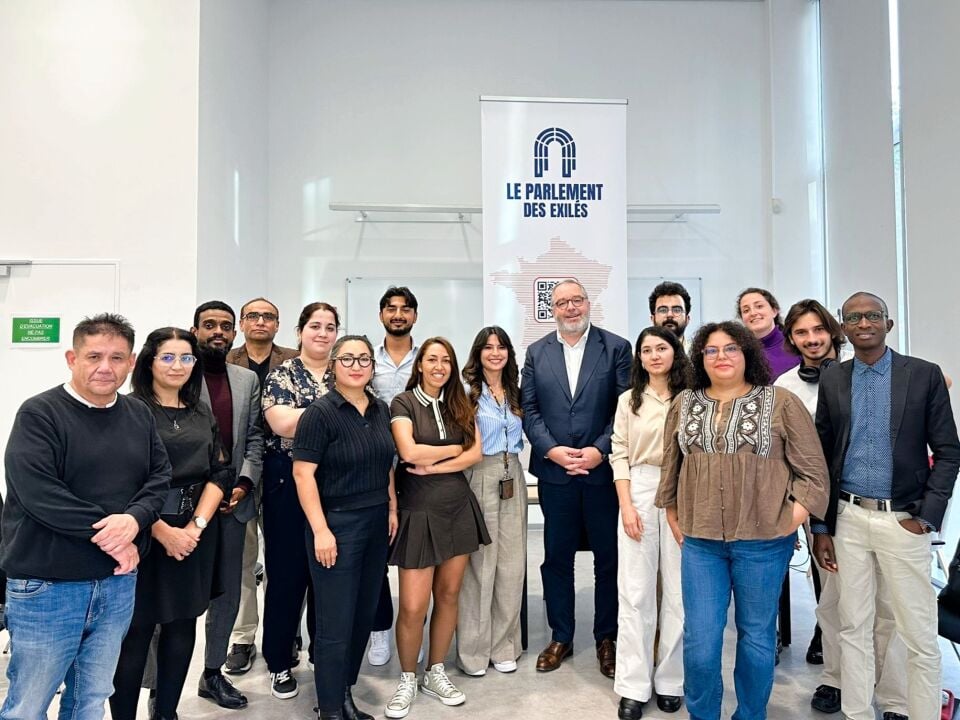
Our association, made up of students, artists and committed citizens who have fled their countries, came up with the idea of the Parliament of Exiles, a space for representation and citizen participation dedicated to exiled populations, where they can express themselves freely and take part in the orientation of public policies. Representatives are democratically elected and then trained in the workings of French institutions so that they can represent the voice of exiles to political bodies. The official launch took place on 8 January 2024 at the Economic, Social and Environmental Council (CESE) in the presence of experts, associations and representatives of civil society. The project is structured around three phases: first the campaign and election, then a one-year university training programme on how the institutions operate, and finally the fulfilment of the mandate.
How did the first elections of the Parliament of Exiles go?
It all happened very quickly. After the official launch of the project, we received over two hundred applications from all over France, even though we had done very little to publicise the initiative! To be eligible, exiles must have been living in France for more than a year, have a proven commitment to community work, have a sufficient level of education (equivalent to at least A-levels) and, above all, have the desire to stay in France and play a full part in the country’s civic life. In the end, around thirty candidates were selected and each was able to present their programme on the Parliament of Exiles website during a six-day express campaign. The elections took place online in July. Nearly 5,500 voters turned out, which was a real success for a ballot organised in the middle of summer! 17 exiles were elected, with an exemplary commitment to gender parity (9 women and 8 men). The programmes focused on very practical issues: access to the job market, education, culture and French language courses, as well as defending the rights of women and gender minorities.
How are elected representatives then trained?
They take a one-year university course on the workings of French institutions and the State to prepare for the “Travaux et Techniques Politiques pour Parlementaires Exilés” diploma , a specialised course created by the University of Paris-Nanterre .
We also work with other partners, depending on their specialisms, such as the Institut Jacques Delors on European integration, CELSA on communication, and Columbia University for its Anglo-Saxon approach. The idea is to have theoretical courses on human rights and the different types of discrimination, but also practical support with workshops on public speaking and leadership techniques, as well as an end-of-study work placement.
Throughout the year, we also offer a programme of visits and meetings: we went to the National Assembly to meet Yaël Braun Privet, at the Court of Auditors, and we also had the opportunity to talk to Rachid Temal, Senator for Val d’Oise, Paolo Artini, representative of the UNHCR, and the economist Gabriel Zucman...
© D.R.
What is the mandate of the elected exiles?
We don’t have the benefit of hindsight yet, as the elected representatives are currently undergoing their university training and their term of office will not begin until September 2026. But first they will need to collaborate to identify and select the priority issues on which they feel it is essential to take action on behalf of exiles, for example housing, access to training, etc. They will then form thematic working groups to reflect, carry out in-depth research and meet with experts in order to make recommendations to political decision-makers and the relevant bodies. And thus act as a link between their constituents and the institutions. Ideally, we would like to offer them an employment contract during their year of office so that they can fully carry out this role with peace of mind.
How is your initiative being received?
We are aware that our approach touches on a delicate subject, but we have received a very warm welcome, particularly from universities, as well as elected representatives and public stakeholders. Many people recognise the innovative nature of this project, which exists nowhere else in the world, except at local level in Germany or at European level via consultative councils. The interest of our approach was also highlighted in a report produced by the Institut pour la Démocratie (IDEM) entitled “Le Parlement des Exilés. Un projet de renouvellement citoyen en temps de crise de la démocratie”, which highlights the need to involve exiled populations in decision-making processes.
How is the Parliament of Exiles a response to the crisis of democracy?
We contribute to strengthening democratic principles by addressing the lack of political representation of an entire segment of society whose voices go unheard.
The Parliament of Exiles also helps to change the way we look at immigration issues and immigrants themselves. We are betting that by giving a voice to people who are sufficiently trained and integrated, they will be able to gain visibility and deconstruct the prejudices in which they are trapped. In an increasingly polarised society, plagued by identity-based divisions and where the interests of exiles are often pitted against those of the rest of the population, our initiative is an opportunity to show that the struggles and rights of some can serve those of others. Giving voice to these new avenues is therefore an opportunity for everyone.