

The "École du feu" initiative: learning to live with wildfire risk
Born in the aftermath of the fire that ravaged the north of Marseille on July 8, 2025, the "École du feu" (School of fire) project, led by the Bureau des guides du GR2013, aims to strengthen residents' ability to understand, anticipate, and live with wildfire risk. How? Through educational walks through Mediterranean landscapes. The initiative is supported by Fondation de France's Crises and disasters action collective.
"The fire has passed, and it will come again. This isn't just about repairing the damage from the fire that happened, but preparing for the ones to come," summarizes Noémie Behr, who coordinates the École du feu project within the Bureau des guides du GR2013 .
In July 2025, a fire that started in the town of Les Pennes-Mirabeau spread to the Estaque district of Marseille: 750 hectares of scrubland and Mediterranean forest were destroyed, along with 90 homes. The shock was immense, both for local residents and for the city as a whole.
In the days following the disaster, affected residents organized themselves into a collective to deal with urgent matters: rehousing, legal procedures, and insurance claims. At the same time, another need quickly emerged: understanding what had happened and learning to better prepare for the future.
Understanding and anticipating the risk
On July 23, 2025, the Bureau des guides du GR2013 association, together with the residents' cooperative Hôtel du Nord, organized a first public gathering bringing together researchers, field experts, and witnesses. "Beyond the trauma and material losses, many residents expressed a desire to understand fire: how it behaves, its ecology, ways to protect against it," Noémie Behr recounts.
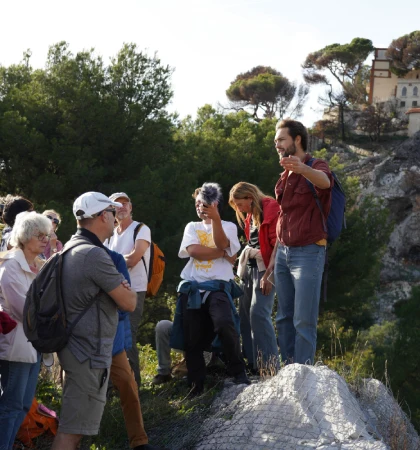
This gathering gave rise to the École du feu project. True to its roots, the association chose walking as its central tool for sharing knowledge. "The walk allows 'expert' knowledge to be transformed into 'situated' knowledge. Participants learn with their senses, by directly observing the landscapes and areas concerned," she explains.
Since October, three half-day educational walks have already been held, bringing together anthropologists, landscape architects, botanists, urban planners, engineers, and residents. As they cross the burned areas, participants share their experiences and knowledge: legal brush-clearing requirements, building vulnerabilities, plant selection, emergency response organization, and the role of local authorities in risk prevention.
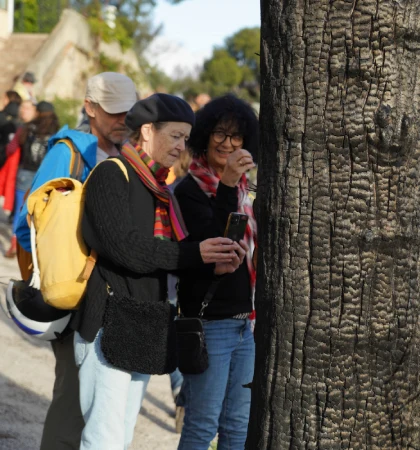
"These sessions in particular allow residents to become informed interlocutors, able to engage more constructively with public authorities," Noémie Behr emphasizes. The goal is to build a shared culture of risk, grounded in observation and knowledge-sharing. As wildfires intensify, residents have an essential role to play in preparing their homes, fostering solidarity, and practicing self-protection.
Learning to act together
Fire prevention and post-fire restoration work often extends beyond the boundaries of private property. The École du feu therefore also seeks to strengthen collective capacity for action, notably by organizing brush-clearing operations in neighborhoods. "Our role isn't to organize every action ourselves, but to provide a space for experimentation, so that residents can gain autonomy and keep these efforts going locally over time," explains Noémie Behr.
Walks are also planned in other parts of the greater Marseille area, particularly in sites affected by older fires, such as Martigues (2020) or Montagne Sainte-Victoire (1989). The goal: to observe regeneration patterns and long-term planning choices.
An educational program for young people
One of the project's main challenges is sustaining engagement over time. To this end, the association places strong emphasis on younger generations.
Already involved in educational and artistic activities with schools in Marseille, the team is developing a new educational program centered on fire, viewed both as a risk and as a component of Mediterranean ecosystems. "Seeing fire only as an enemy prevents us from understanding it. For example, certain plants and trees reproduce or spread thanks to it," Noémie Behr notes. "It's by grasping fire in all its complexity that we can better prepare for it."
Artistic practice also plays a central role in the project. Artist and designer Garance Maurer, who has worked on the subject of fire for several years, has begun a two-year residency alongside the association. Art makes it possible to build sensory, experiential knowledge and to make these issues accessible in ways that go beyond purely technical discourse.
Accounts of the first walks are already available online, and the association hopes to go further by co-creating new formats for sharing knowledge with residents. A booklet of recommendations, intended to inform dialogue with local authorities, is also expected to be published by the end of the year.